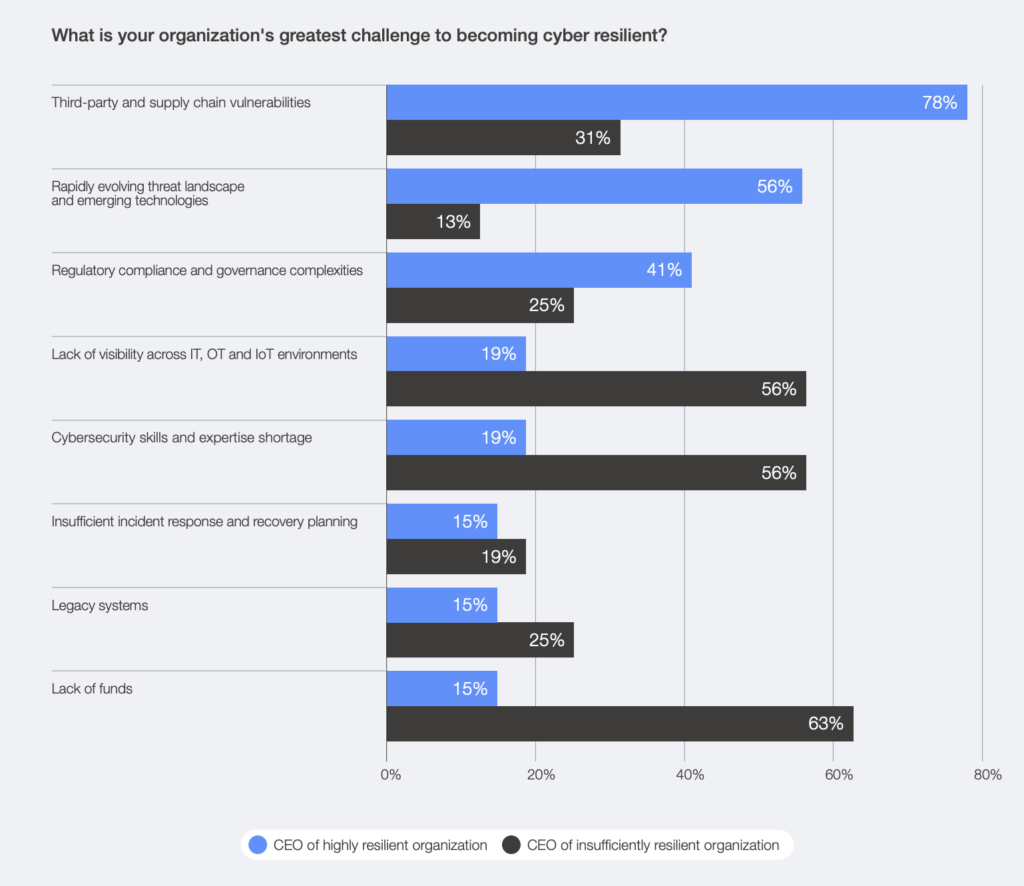
- 65% of large organizations say third-party cyber risk is now a major barrier to cyber resilience
- 94% of leaders say AI is the biggest factor reshaping cyber risk in 2026
- 64% of organizations factor geopolitical cyber threats into cyber planning
- 31% of leaders report low confidence in their country’s cyber incident readiness.
For years, cybersecurity strategies were built around a clear boundary, protecting the enterprise network, secure internal systems, and control access.
That model no longer holds.
The World Economic Forum’s Global Cybersecurity Outlook 2026 shows cyber risk increasingly entering organizations through external partners, not internal infrastructure. Suppliers, SaaS vendors, logistics providers, and technology partners now sit directly inside core business operations.
As dependency grows, so does exposure, often outside the visibility of security teams.
Third-party cyber risk is rising faster than defences
The most striking signal from the report is scale. Nearly two-thirds of large enterprises say third-party cyber risk is actively blocking their ability to become resilient, a sharp rise from the year before. This increase comes despite higher cybersecurity spending and wider adoption of security platforms.
The issue is not lack of tools. It is a lack of control beyond the enterprise.
Organizations may harden their own environments, but resilience collapses when a single vendor operates below acceptable security standards.
New AI models, automation platforms, data enrichment tools, and embedded APIs are frequently introduced via external vendors. While these tools drive speed and productivity, they also create opaque data flows and shared accountability gaps.
The report highlights that 94% of leaders see AI as the dominant cyber risk driver in 2026, not because of AI alone but because of how rapidly it is integrated across vendor ecosystems.
In practice, AI is expanding the attack surface sideways, across supply chains rather than inside company walls.
Also read: 50% of Companies to Raise Supply Chain Tech Budgets in 2026: APQC
Uneven cyber maturity across the supply chain
The report also underscores a growing imbalance. Large enterprises continue to strengthen governance, monitoring, and response capabilities. But many smaller suppliers lack comparable resources, skills, or cyber frameworks.
This creates a structural vulnerability, highly secured organizations increasingly dependent on partners that cannot meet the same standards.
In digital supply chains, resilience is only as strong as the least prepared participant.
Geopolitics adds a new layer of exposure
Cyber risk in 2026 is no longer purely technical.
With 64% of organizations now factoring geopolitical threats into cyber planning, supply chains spanning multiple regions face risks shaped by political instability, regulatory fragmentation, and uneven national cyber readiness.
The report shows declining confidence in countries’ ability to respond to major cyber incidents particularly across cross-border environments where responsibility and response coordination remain unclear.
For global supply chains, this introduces risk factors no internal security team can fully control.
From vendor trust to ecosystem governance
Taken together, these signals point to a fundamental shift. Traditional approaches like annual vendor questionnaires, contractual assurances, and compliance checklists are no longer sufficient. They provide static snapshots in a dynamic threat environment.
Leaders are beginning to rethink cybersecurity as an ecosystem governance challenge, not just an internal IT responsibility.
Visibility, continuous monitoring, and shared accountability models are emerging as critical capabilities for managing third-party risk at scale.
What this means for vendors across AI and security apace
For technology and service providers, cybersecurity posture is becoming a business differentiator.
Enterprises increasingly expect:
- Continuous security visibility rather than periodic audits
- Transparency into AI usage and data handling practices
- Clear ownership of shared cyber responsibility
In 2026, vendors that can demonstrate resilience are more likely to earn enterprise trust and long-term contracts.